Medical Tourism in India: Complete Guide for International Patients in 2026
Choosing the right country for medical treatment is an important decision. International patients often consider the quality of healthcare, specialist doctors, treatment costs, hospital facilities, travel arrangements, language support, and the overall patient experience before travelling abroad for treatment.
India has emerged as a major destination for international healthcare, offering advanced medical facilities, experienced specialists, internationally recognized hospitals, and a wide range of treatment options.
For patients travelling from Africa, the Middle East, Southeast Asia, the United Kingdom, the United States, and other regions, India can provide access to complex medical procedures at comparatively affordable costs.
But medical tourism involves much more than choosing a hospital and booking a flight. Patients need to understand the treatment options, hospital selection process, medical documents, estimated costs, visa requirements, travel arrangements, accommodation, treatment timeline, and follow-up care.
This complete guide to medical tourism in India in 2026 explains everything international patients should know before planning their medical journey.
What Is Medical Tourism?
Medical tourism refers to travelling to another country to receive medical, surgical, dental, diagnostic, or wellness-related treatment. Patients may travel internationally for several reasons, including:
- Access to specialized medical expertise
- Advanced medical technology
- Shorter waiting times
- Treatment availability
- Cost considerations
- Access to complex procedures
- Second medical opinions
- Specialized rehabilitation and recovery services
India's healthcare ecosystem includes hospitals and specialists across areas such as cardiology, oncology, orthopedics, neurology, neurosurgery, organ transplantation, fertility treatment, gastroenterology, urology, and many other specialties.
Why Choose India for Medical Treatment?
India has become an attractive healthcare destination for international patients because of its combination of medical expertise, technology, hospital infrastructure, and comparatively competitive treatment costs.
1. Experienced Specialist Doctors
India has a large pool of doctors and medical specialists working across major specialties. International patients can access specialist doctors in areas such as:
- Cardiology and cardiac surgery
- Oncology
- Orthopedics
- Neurology and neurosurgery
- Organ transplantation
- Gastroenterology and urology
- Nephrology
- Fertility and IVF
- Pulmonology and ophthalmology
- Dental care
Patients should evaluate doctors based on their qualifications, experience, specialization, hospital affiliation, and suitability for the specific medical condition.
2. Advanced Hospitals and Medical Technology
Major Indian cities have hospitals equipped with advanced diagnostic, surgical, intensive-care, and rehabilitation facilities. Depending on the treatment, international patients may have access to advanced imaging and diagnostics, minimally invasive procedures, robotic-assisted surgery, modern operating theatres, intensive care units, advanced cardiac care, cancer treatment technologies, organ transplant programs, and specialized rehabilitation.
However, facilities and expertise vary between hospitals, so patients should compare hospitals based on the specific treatment they require rather than choosing solely based on reputation.
3. Competitive Treatment Costs
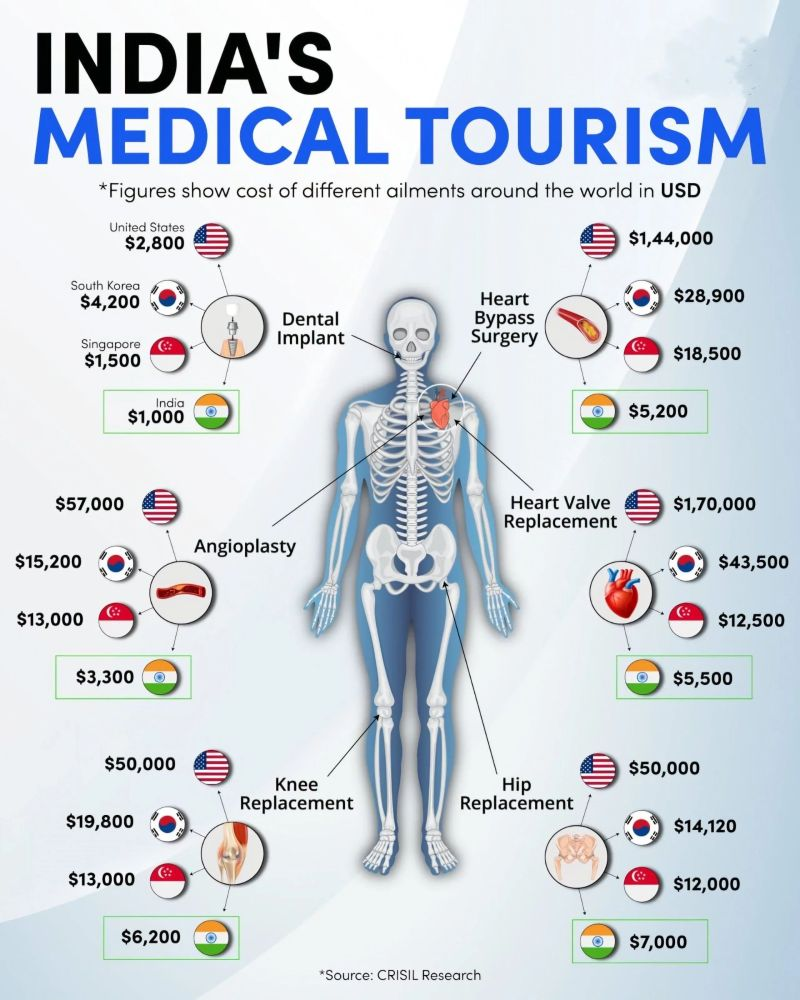
One of the major reasons patients consider India is the comparatively lower cost of many medical procedures compared with several Western countries. The final cost depends on factors such as type of treatment, hospital, doctor or specialist, medical condition, diagnostic tests, length of hospital stay, type of room, medication, surgical complexity, and recovery and rehabilitation requirements.
Patients should always request a personalized treatment estimate rather than relying on a general price found online — our cost estimator is a good starting point for a rough range.
4. Wide Range of Medical Specialties
India offers treatment across a broad range of medical specialties. International patients commonly explore India for cardiology (angioplasty, bypass surgery, valve replacement, structural heart procedures, cardiac diagnostics), oncology (cancer diagnosis, chemotherapy, radiation therapy, cancer surgery, targeted treatment options), orthopedics (knee and hip replacement, spine surgery, sports injury treatment, joint reconstruction), neurology and neurosurgery (brain surgery, spine procedures, stroke-related care, complex neurosurgical procedures), organ transplantation (kidney and liver transplant, and other specialized transplant services where legally and medically appropriate), and fertility treatment (IVF, fertility evaluation, assisted reproductive procedures).
The availability of a specific procedure depends on the patient's medical condition, hospital capabilities, and applicable Indian regulations.
Best Cities in India for Medical Tourism
International patients can find advanced healthcare facilities across several Indian cities.
Mumbai
Mumbai is one of India's major healthcare and international travel hubs. The city has several established hospitals and specialist centers covering complex medical treatments.
Delhi and NCR
Delhi and the National Capital Region offer a large concentration of tertiary-care hospitals and specialists across multiple medical specialties.
Hyderabad
Hyderabad has developed into an important healthcare destination with hospitals offering advanced treatment across cardiology, oncology, transplantation, orthopedics, neurology, and other specialties.
Chennai
Chennai is known for its strong healthcare ecosystem and attracts international patients for several specialized treatments.
Bengaluru
Bengaluru combines advanced healthcare facilities with strong medical and technology ecosystems and offers treatment across numerous specialties.
Kochi
Kochi is another important healthcare destination, particularly for patients from parts of the Middle East, Africa, and neighboring regions.
How Should You Choose a City?
The best city depends on your medical condition, required procedure, preferred hospital, specialist availability, travel connections, accommodation requirements, budget, and recovery period.
The best city is not necessarily the city with the most famous hospitals. The right choice is the location with the appropriate specialist and treatment facilities for your individual medical needs.
How Much Does Medical Treatment Cost in India?
There is no single price for medical treatment in India. The cost varies significantly depending on the procedure, hospital, medical condition, doctor, and treatment requirements.
For example, the total cost of a surgical procedure may include initial consultation, diagnostic tests, imaging, doctor fees, hospital charges, operating theatre charges, anesthesia, medicines, medical devices or implants, ICU charges, room charges, follow-up consultations, and rehabilitation.
International patients should also consider additional travel-related expenses such as visa fees, flights, accommodation, local transportation, food, companion expenses, and travel insurance where applicable.
Important: online treatment prices should be treated as indicative estimates only. A hospital should provide the final treatment plan and cost estimate after reviewing the patient's medical records.
How to Choose the Best Hospital in India
Choosing a hospital is one of the most important steps in medical tourism. See our guide to the best hospitals in India for international patients for a closer look at specific options. Before making a decision, consider the following.
Hospital Accreditation
Check whether the hospital has relevant national or international accreditation and quality certifications.
Specialist Experience
Research the doctor's qualifications, specialization, experience, hospital affiliation, and relevant procedure experience.
Treatment Infrastructure
Check whether the hospital has the facilities required for your particular treatment.
International Patient Services
For international patients, useful services may include international patient departments, language assistance, visa support, airport transfers, accommodation assistance, dedicated patient coordinators, and medical documentation support.
Transparency
Ask for a written estimate that clearly explains what is included and excluded.
How to Get a Medical Opinion Before Travelling to India
International patients generally do not need to travel to India simply to obtain an initial medical opinion. Many hospitals and healthcare providers can review medical records remotely.
You may be asked to provide previous medical reports, blood test results, imaging reports, CT or MRI scans, X-rays, pathology reports, current medications, previous surgery records, and doctor's notes.
A specialist can review the available information and advise whether further evaluation or treatment in India may be appropriate. However, a remote opinion does not replace an in-person medical examination when one is medically necessary.
Medical Visa for India
Foreign patients travelling to India specifically for medical treatment may need an appropriate medical visa or electronic medical visa depending on their nationality and eligibility. India also provides medical attendant visa options for eligible accompanying individuals.
Visa rules, eligibility, permitted duration, documentation, and application procedures can change. Therefore, patients should verify the latest requirements through the official Government of India visa resources before making travel arrangements.
Typical documentation may include a valid passport, medical documents, hospital or treatment-related documentation, visa application, recent photographs where required, and financial or supporting documents where applicable.
Do not rely on outdated blog posts for visa requirements.
What Documents Should International Patients Prepare?
Before travelling to India, organize your medical documents carefully.
Medical Documents
Prepare digital and physical copies of your passport, medical history, diagnosis reports, blood reports, imaging reports, MRI/CT/X-ray records, biopsy or pathology reports, previous prescriptions, current medication list, previous surgery reports, and allergy information.
Travel Documents
Keep copies of your passport, visa, flight booking, hotel or accommodation information, hospital appointment confirmation, and emergency contact information.
Keeping documents in a secure digital folder can make communication with hospitals and doctors easier.
What Is the Medical Tourism Process in India?
The medical tourism journey can generally be divided into several stages.
Step 1: Share Your Medical Records
Provide your medical reports and relevant information to the hospital or medical coordination team.
Step 2: Get a Specialist Opinion
The appropriate specialist reviews your medical information and recommends possible treatment options.
Step 3: Receive a Treatment Plan
You may receive information about the recommended treatment, expected hospital stay, estimated treatment cost, possible additional investigations, recovery period, and follow-up requirements.
Step 4: Plan Your Travel
Once you decide to proceed, arrange your medical visa, flights, accommodation, airport transfers, and local transportation.
Step 5: Arrive in India
An international patient coordinator can help coordinate hospital visits and other practical requirements.
Step 6: Consultation and Treatment
The patient undergoes the required medical evaluation and treatment according to the specialist's recommendation.
Step 7: Recovery and Follow-Up
After treatment, the doctor determines the appropriate recovery and follow-up plan. The patient should understand when they can safely travel home and what follow-up care will be required after returning.
How Long Do International Patients Need to Stay in India?
The length of stay depends entirely on the treatment. A patient may need time for initial consultation, diagnostic tests, treatment or surgery, hospital recovery, follow-up consultation, and medical clearance before travel.
Simple procedures may require a shorter stay, while major surgeries or complex treatments may require several weeks or longer. Patients should ask the treating hospital for an estimated timeline before booking return flights.
Where Can International Patients Stay in India?
International patients may choose from hotels, serviced apartments, guest houses, hospital-associated accommodation, or short-term rental properties.
The best option depends on treatment duration, hospital location, mobility requirements, family size, budget, and need for medical assistance. For patients recovering from surgery, accommodation close to the hospital can be especially convenient.
What About Language and Communication?
India is a multilingual country, and English is widely used in the medical and healthcare environment. Many major hospitals also provide international patient services and language assistance for patients who require it.
For patients travelling from countries where English is not commonly spoken, professional interpretation or translation support can help reduce communication difficulties. Clear communication is particularly important when discussing diagnosis, treatment options, medication, risks, recovery instructions, and follow-up care.
Is Medical Tourism in India Safe?
Safety should always be the first priority when choosing medical treatment abroad. Patients should research hospital credentials, doctor qualifications, hospital accreditation, relevant specialist experience, treatment outcomes where reliable information is available, infection-control practices, emergency facilities, ICU capabilities where relevant, and international patient services.
Patients should also provide complete and accurate medical information to their treating doctors. No healthcare provider can guarantee a specific medical outcome, and every medical procedure carries potential risks.
What Should International Patients Ask Before Choosing a Hospital?
Before confirming treatment, consider asking who will be your treating specialist, how many years of experience the doctor has with this procedure, what treatment options are available, what tests are required before treatment, what is included in the estimated cost, what costs are excluded, how long you will need to stay in India, how long you will need to stay in the hospital, what the potential risks and complications are, what follow-up care you will need, whether the hospital can assist international patients, what documents are required before arrival, whether the hospital can provide medical visa-related documentation where applicable, and when you can safely travel back home.
Why Use a Medical Tourism Facilitator?
Planning medical treatment in another country can be complicated, especially when patients are unfamiliar with hospitals, doctors, travel arrangements, visa requirements, and local services. A medical tourism facilitator can help coordinate different parts of the journey.
Depending on the service provider, support may include hospital selection, doctor coordination, medical record sharing, appointment scheduling, treatment estimate coordination, travel planning, visa documentation guidance, airport transfers, accommodation assistance, translation support, local coordination, and follow-up coordination.
However, patients should always verify the credentials of any medical tourism facilitator and understand exactly what services are being provided.
How GativCare Helps International Patients
At GativCare, our goal is to make the medical travel journey easier to understand and coordinate for international patients seeking treatment in India. We help patients navigate the process from the initial inquiry through treatment planning and travel coordination.
Hospital & Doctor Coordination
We help patients identify suitable hospitals and specialists based on their medical requirements.
Medical Report Coordination
Patients can share their available medical reports so they can be organized for specialist review.
Treatment Planning
We help coordinate information about treatment options, estimated timelines, hospital requirements, and related arrangements.
Medical Travel Support
We assist international patients with practical aspects of travelling to India for healthcare.
Visa Documentation Guidance
We help patients understand the documents they may need for their medical travel process. Contact our team with your treatment details and we'll guide you through it. Visa eligibility and approval remain subject to applicable government rules.
Accommodation & Local Support
We can help coordinate practical arrangements such as accommodation and local transportation depending on the patient's requirements.
International Patient Assistance
Our objective is to provide a more organized experience for patients and their families while they navigate healthcare in India.
Advantages and Considerations
Advantages
- Access to specialized doctors
- Advanced hospital infrastructure
- Competitive treatment costs
- Wide range of specialties
- International patient services
- Multiple healthcare destinations
- Access to second opinions
Things to Consider
- Treatment outcomes cannot be guaranteed
- Hospital quality varies
- Travel and accommodation add to total cost
- Visa requirements must be checked
- Follow-up care must be planned
- Patients need to research hospitals carefully
- Medical records should be complete
Is India Right for Your Medical Treatment?
India may be a suitable destination for patients looking for access to specialized healthcare, experienced medical professionals, modern hospitals, and potentially more affordable treatment options. However, the right destination depends on the patient's individual medical condition.
Before travelling, patients should obtain a professional medical opinion, research suitable hospitals, verify doctor qualifications, understand the treatment plan, request a detailed cost estimate, check current visa requirements, plan accommodation, arrange travel and local transportation, and understand post-treatment follow-up requirements.
Medical tourism should always be approached as a healthcare decision first and a travel decision second.
Frequently Asked Questions
Is India good for medical tourism?
India is a major destination for international healthcare and offers treatment across many medical specialties. Patients should evaluate hospitals and specialists based on their individual treatment requirements.
Why is medical treatment cheaper in India?
Treatment costs can be lower than in some countries because of differences in healthcare operating costs, infrastructure, staffing, and other economic factors. Actual costs vary by procedure and hospital.
Which city is best for medical treatment in India?
There is no single best city for every patient. Delhi NCR, Mumbai, Hyderabad, Chennai, Bengaluru, and other cities have major hospitals and specialists. The appropriate city depends on the required treatment and specialist.
Can foreigners get medical treatment in India?
Yes. Foreign patients can seek medical treatment in India, subject to applicable immigration, visa, healthcare, and regulatory requirements.
Do I need a medical visa to travel to India?
Depending on your nationality, purpose of travel, and eligibility, you may need a medical visa or eligible electronic medical visa. Always verify current requirements through official Indian government sources before travelling.
Can a family member travel with a medical patient?
Eligible accompanying individuals may be able to travel using the applicable medical attendant visa arrangements, subject to current government requirements.
Can I get a medical opinion before travelling to India?
Yes. Many hospitals can review medical records remotely and provide an initial specialist opinion. An in-person examination may still be required before treatment.
How long should I stay in India after surgery?
The required stay depends on the procedure, recovery, and doctor's assessment. Your treating hospital should provide an estimated timeline before you arrange your return journey.
Can GativCare help international patients find hospitals in India?
GativCare can help international patients coordinate hospital and specialist options based on their healthcare requirements, along with other medical travel support services.
Final Thoughts
India offers international patients access to a broad healthcare ecosystem that includes experienced specialists, advanced hospitals, modern medical technology, and a wide range of treatment options. But choosing medical treatment abroad requires careful planning.
The most important step is to identify the right doctor and hospital for your specific medical condition, understand the proposed treatment, review the estimated costs, prepare the required documentation, and plan your travel and recovery properly.
If you are considering travelling to India for medical treatment, GativCare can help you navigate the process and coordinate the next steps.
Your health journey deserves the right guidance.
Plan Your Medical Treatment in India with GativCare
Share your medical reports with GativCare and let our team help you explore suitable treatment options in India. Contact GativCare today to begin your medical journey.
Have questions about this treatment?
Get a free consultation with our medical coordinators
Get Free Consultation